
A transcript connected to the cut
Plan navigation between a script passage and its recording segment, making revision and localization review easier to follow.
MRGI AUDIO / AUDIO EDITING & MIXING
COMING SOONRecord, arrange, edit, and mix audio tracks with effects and automation. Connect production work to transcripts, language versions, and usage records.
For audio and localization teams coordinating recordings, language variants, and usage rights.
Try the interactive demo Browse all 15 appsMEET THE WORKSPACE
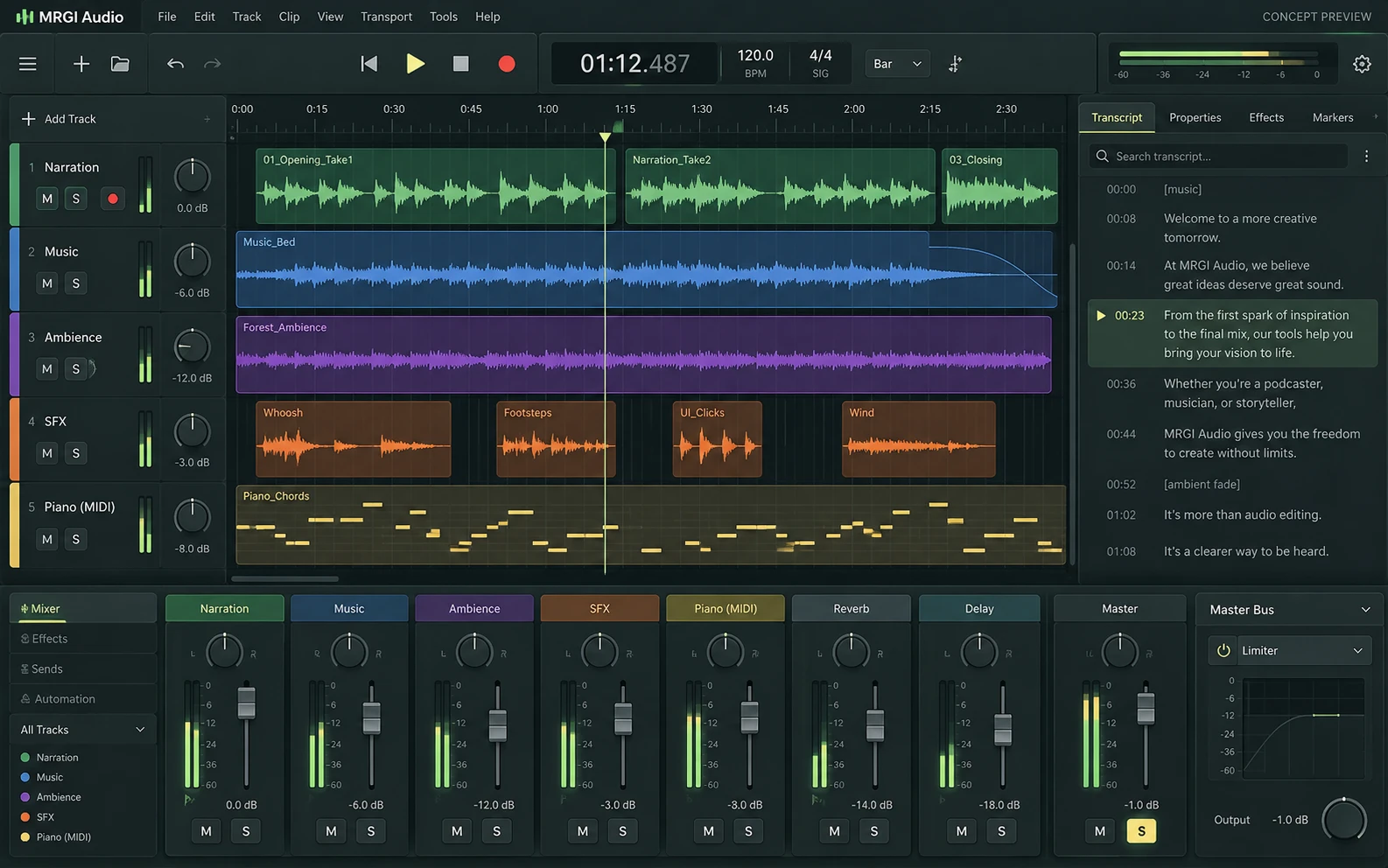
An audio workstation with track waveforms, a transport and timeline, mixing controls, and a proposed transcript-linked editing panel.
Proposed design with synthetic content. This is not a released application; features and appearance may change.
EXPLORE THE IDEA / HANDS ON
Choose sample transcript lines and inspect the corresponding synthetic waveform interval and selected duration.
Choose sample transcript lines and inspect the corresponding synthetic waveform interval and selected duration.
Synthetic inputs. Local computation. No uploads.The waveform is illustrative and contains no recording. The demo does not transcribe, synthesize, or edit a person’s voice.
Read the full Audio workflow guide00:12 A new perspective starts with a closer look.
00:18 These are the stories we bring back from the field.
00:24 And the ideas we carry into what comes next.
PROPOSED AUTOMATION RECIPE
Use an approved Author script, deliver reviewed audio to Motion, and retain production records in Evidence.
Link the source recording and reviewed script.
Prepare language variants with their production context.
Review rights records and export the delivery collection.
Original interface mockup with synthetic content. This is a design concept, not a screenshot of a released application. Switch views to explore the proposed workflow.
01 / THE WORK BEHIND THE WORK
A localized recording has a script, a source edit, a performer, and a set of permissions. Audio is being designed to keep those relationships understandable across languages and production revisions.
The source foundation is imported. Transcript editing, localization workflows, and consent-aware delivery are planned.
02 / THE PLANNED TOOLKIT
The intended Audio experience.
Feature availability will be confirmed before release.
A CLOSER LOOK / FEATURE DESIGN
Explore the behavior behind the feature names: what the product would do, and what the reviewer would still need to decide.
Keep script, recording, language version, and usage context together through revisions.
03 / THE MRGI DIRECTION
Three product-specific priorities shaping the proposed MRGI experience.
Plan navigation between a script passage and its recording segment, making revision and localization review easier to follow.
Keep each localized output tied to the approved source script, recording, and production settings.
Bring usage and consent records into the review step. The record supports a decision; it does not itself grant rights or validate consent.
These are development goals, not claims of shipped features or market exclusivity. AI, local operation, and automation are shared foundations—not the entire product distinction.
04 / BETTER CONNECTED
Use an approved Author script, deliver reviewed audio to Motion, and retain production records in Evidence.
Link the source recording and reviewed script.
Prepare language variants with their production context.
Review rights records and export the delivery collection.
Planned transcription or translation assistance must identify its provider and output for review. Voice synthesis would require explicit permission and valid usage rights.
Cross-app access is planned around selected resources and explicit consent. Ordinary local editing should not require uploading your files.
 CONCEPT PREVIEW
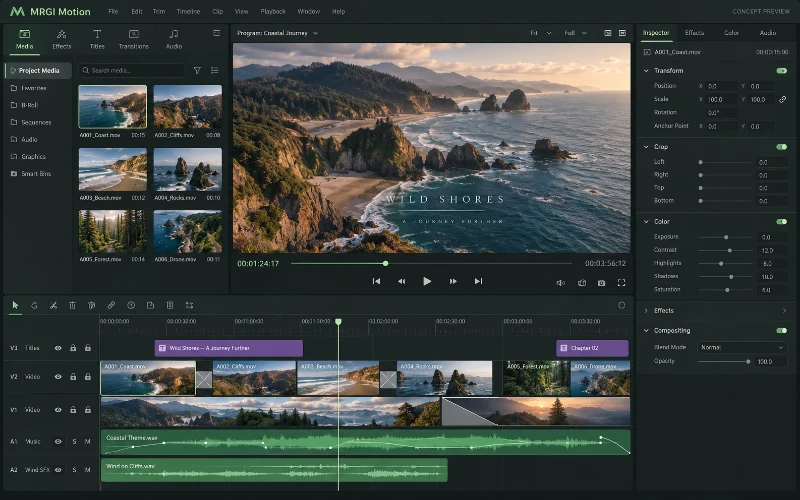
Video editing
Arrange video clips and audio on a multitrack timeline. Add transitions, adjust the picture, and prepare reviewed deliveries for different formats.
 CONCEPT PREVIEW
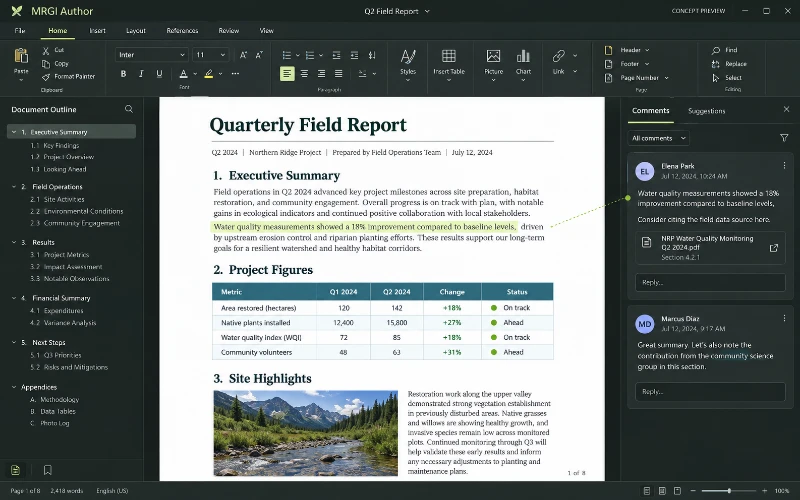
Word processing
Write and format documents with headings, tables, images, comments, and revisions. Link report content to reviewed data and source documents.
 CONCEPT PREVIEW
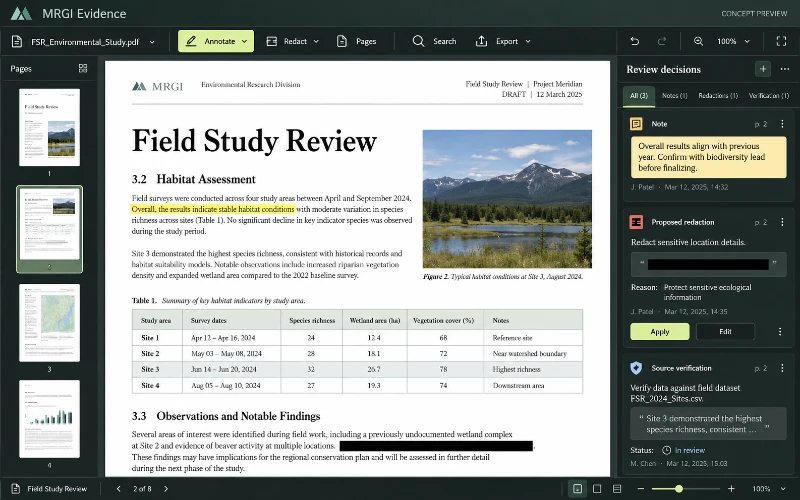
PDF editing & review
Read, annotate, organize, and redact PDFs. Assemble reviewed documents and their sources into a verifiable evidence packet.
BUILT ON OPEN-SOURCE FOUNDATIONS
Multitrack audio, DSP, automation, MIDI models, and plugin hosts exist in SoundCraft. Rights-aware localized production is the proposed MRGI focus. Read the source credits ↗
MRGI AUDIO / COMING SOON
Explore the suite today. Availability and pricing will follow.